of current or recent U.S. online daters felt disappointed by people they encountered at least sometimes.
Pew · 2023Fundraising now · investor materialsSeptember 2026
Personal-intelligence software · dating first
Personal intelligence
for the relationships
that shape us.
Wonder builds a living, revisable model of the individual. Dating is the first application.
Pre-seed · raising $2.5M now
01
The problem
Dating asks people to choose before they understand.
Profiles compress the person. Preferences describe aspiration. Real compatibility emerges partly in interaction—after the decision to meet has already been made.
of people who have used online dating describe the overall experience as negative.
Pew · 2023The missing layer
Not more discovery. Better interpretation before, during, and after choice.
Evidence and limits+
These facts establish category pain, not demand for Wonder. Independent cohort behavior remains the central test.
02
The product
Assessment → Mirror → Introduction → Member Home.
The individual—not the profile—is the starting point. WONDER interprets first, introduces selectively, and keeps learning after two people meet.
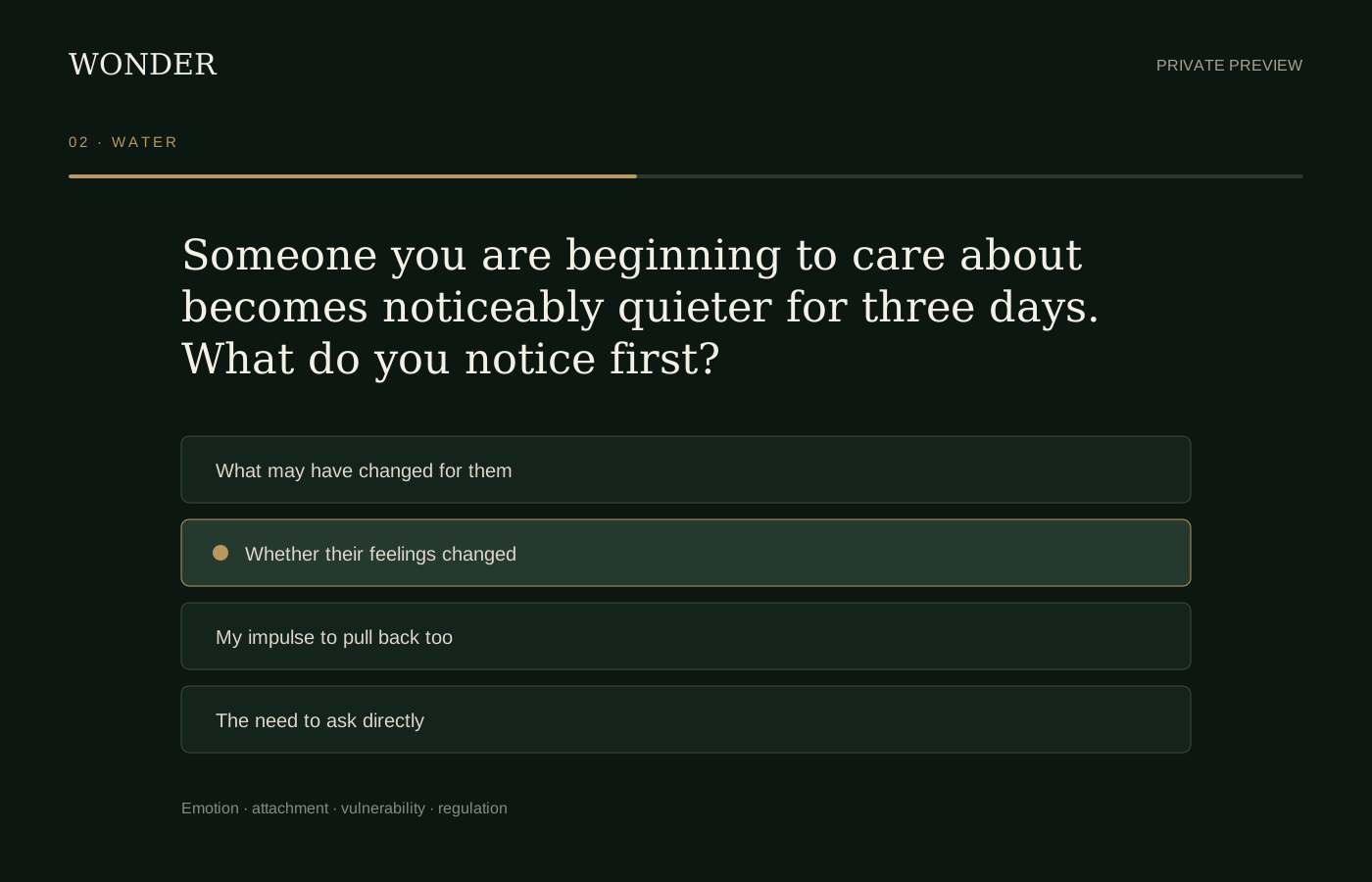
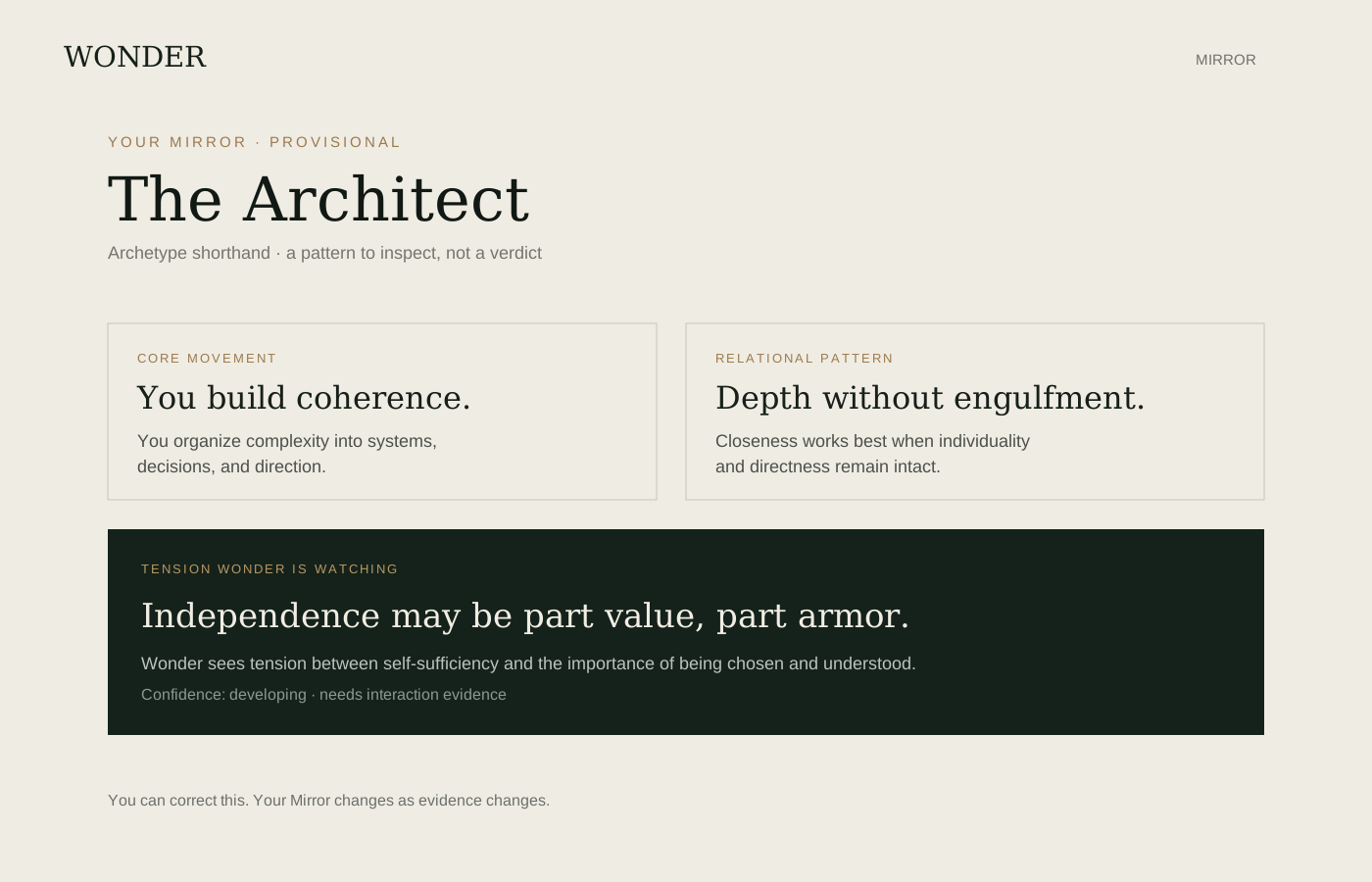
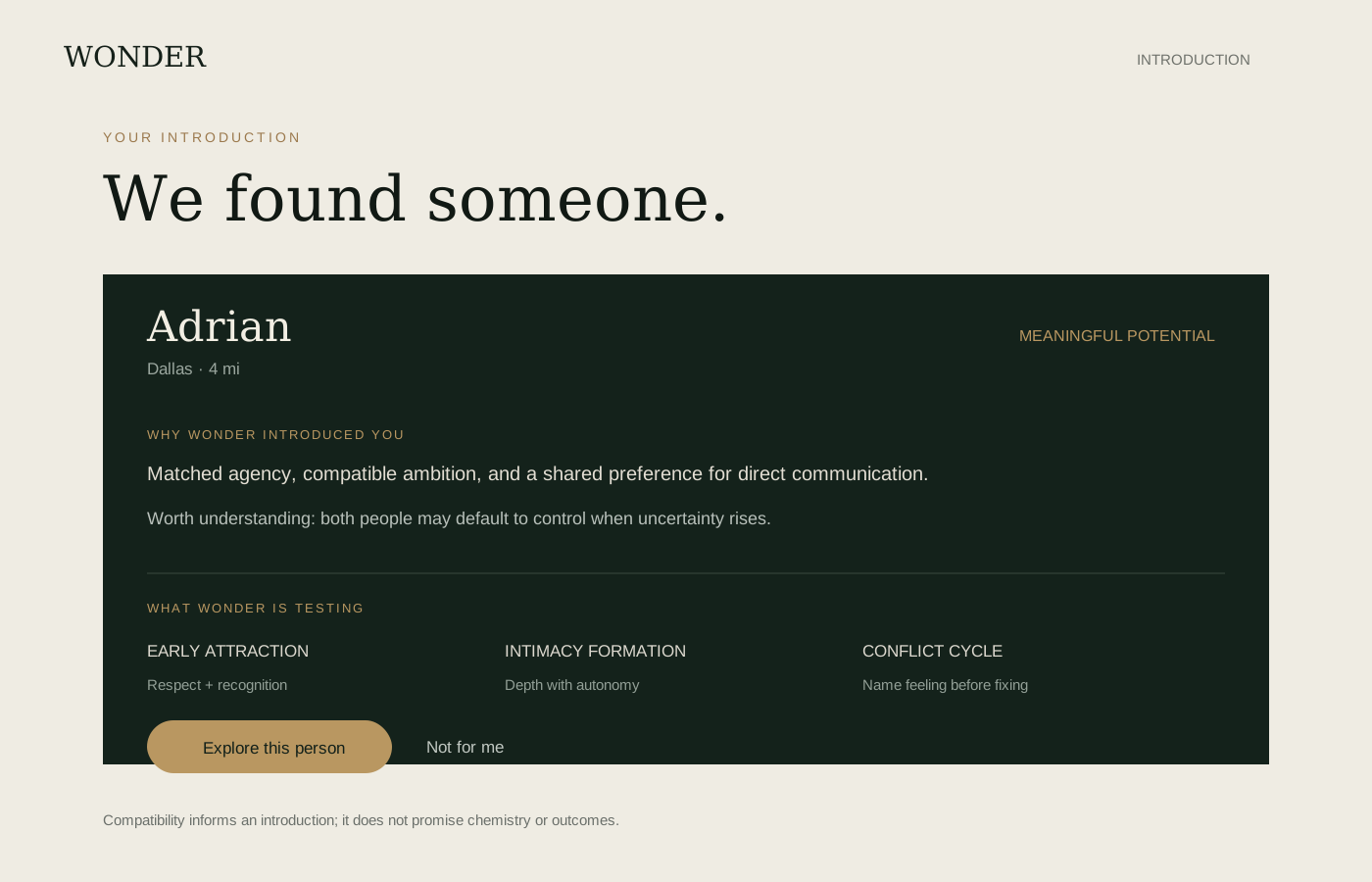
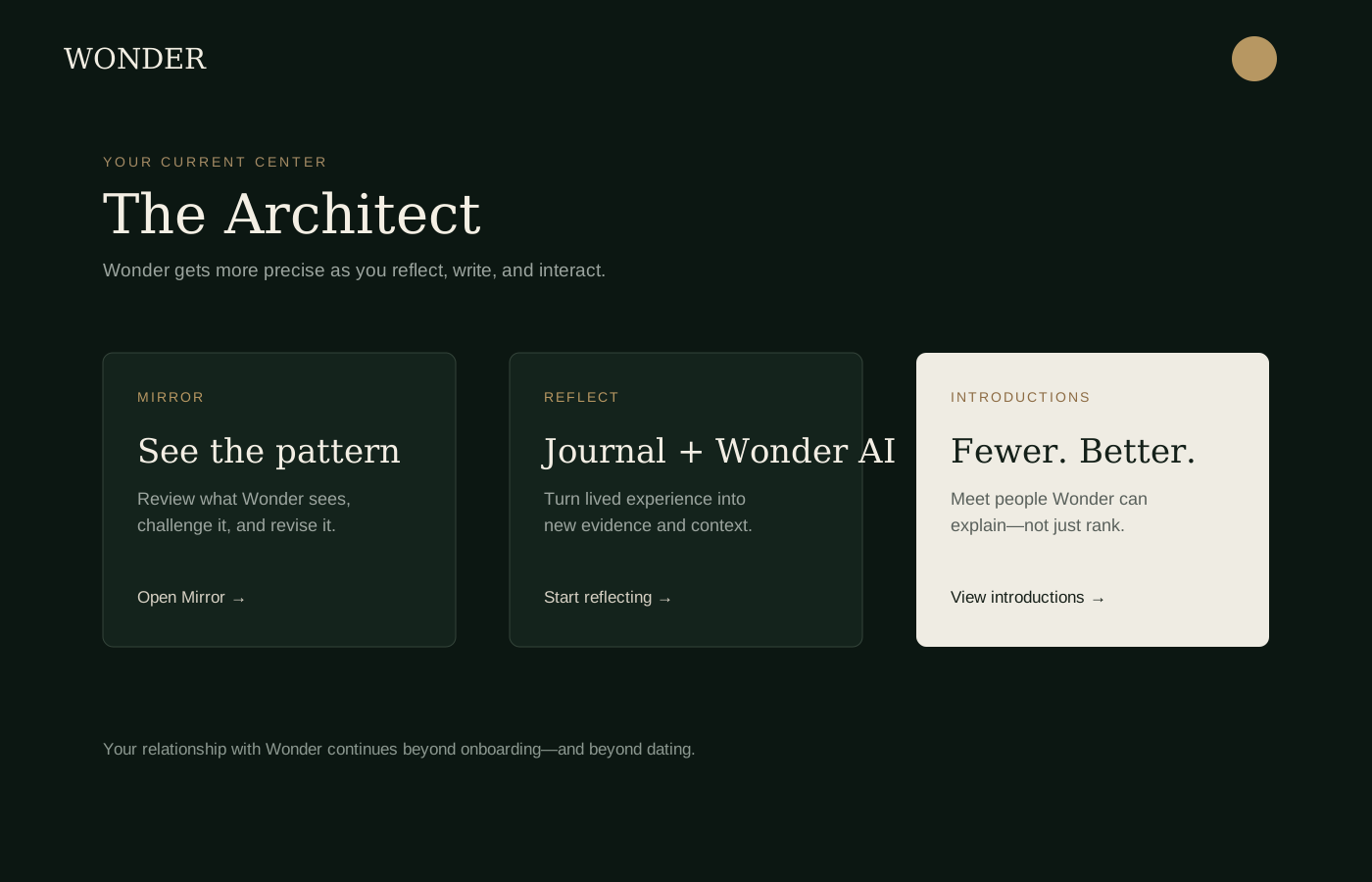
Functional MVP Current assessment, Mirror, member home, introduction, feedback, and account flows.
Worked product example
Response → bounded claim → Mirror → introduction → revision.
- EvidenceA user describes what happens under relational uncertainty.
- InterpretWonder forms a sourced claim with confidence and an active alternative.
- MirrorThe user inspects, corrects, or rejects the claim before it affects a decision.
- ChooseA reciprocal opportunity explains fit, tension, and what remains unknown.
- LearnPost-date evidence raises, lowers, or leaves the claim unresolved.
Product constraint
No feed. No chemistry claim. No simulated certainty.
03
The two-loop system
Self-understanding is the durable product. Dating is the first learning loop.
Relational evidenceChooseMeetExperienceLearn
Personal intelligenceObserveInterpretReflectRevise
The personal model creates value before a match. Dating supplies high-signal outcomes that make the model more accurate.
A relationship does not end the product; it changes the evidence available to it.
The model serves the person across relationship status.04
Governed interpretation
A governed interpretation system—not a chatbot with memory.

The product beneath the interface
Foundation models are replaceable infrastructure.
The governed learning system and trusted user relationship are the product.
Self, other, dyad, development, and change remain structured over time.
Reported facts, observed behavior, inference, and uncertainty remain distinguishable.
Alternative explanations, disclosure permissions, and policy limits constrain every output.
Predictions resolve against behavior, allowing confidence to rise, fall, or remain unknown.
Concrete trace
One response becomes a bounded, revisable recommendation.
Internal visualization of modular reasoning domains—not a neurological model or diagnostic map.
05
Why now
The dating category is moving from engagement volume toward outcome quality.
Match payers
−5%2025; revenue approximately flat
Bumble payers
−11.5%2025; app revenue fell 9.6%
Hinge revenue
+22%Q2 2026; global MAU +13%
Inference cost
>280×GPT-3.5 level, Nov. 2022–Oct. 2024
Interpretation
Incumbents are under pressure, intentional dating is growing, and sustained AI interaction is economically plausible. These conditions create an opening; they do not prove demand.
Timing sources+
Company-reported results and Stanford cost data are dated and linked.
06
Initial customer
Start with intentional Dallas daters who already invest in understanding themselves.
Adults 25–38; relationship-oriented; dissatisfied with volume-based apps; willing to complete reflective onboarding; already engaging in therapy, coaching, journaling, wellness, or structured self-development; willing to pay for better judgment, not more inventory.
Intentional + reflective
Committed relationship intent. Completes minimum viable understanding. Accepts bounded uncertainty and mutual consent.
Reciprocal supply
Lives inside a priority preference cell with sufficient eligible candidates on both sides.
product + safety
balanced members
activated members
same core gates
Research basis+
44% of current or recent users cited finding a long-term partner as a major reason for using online dating.
07
Evidence and validation
A functional end-to-end MVP exists. Consumer pull and system lift remain to be proven.
System exists
Assessment, Mirror, member home, introduction, feedback, account flows, and Wonder Mind v1 logic.
Activation + trust
Completion, first useful Mirror, meaning, correction, return, deeper disclosure, burden, safety, and willingness to pay.
Independent behavior
Standalone retention, baseline lift, timely bilateral dates, paid conversion, repeat use, referral, and improving margin.
Behavioral evidence ladder
- 01Invited
- 02Started
- 03Minimum profile
- 04Mirror received
- 05Mirror meaningful
- 06Intro consent
- 07Qualified offer
- 08Bilateral yes
- 09Confirmed date
- 10Second-date intent
- 11Reflect / pay / repeat / refer / graduate
Every result carries cohort dates, denominator, sample size, founder familiarity, assistance level, and acquisition source.
08
Business model
Free understanding. Monetize qualified action. Extend lifetime only after value repeats.
Wonder is not launching four businesses at once. Each revenue layer is sequential, separately measured, and contingent on the product earning the next behavior.
Wonder Core
$0Foundational Mirror, correction rights, and match eligibility.
MVPQualified introduction
$19–$29 / memberBoth people independently accept and authorize payment; only then does Wonder charge and reveal.
First pricing testWonder Individual
$18–$24 / monthLiving Mirror, longitudinal synthesis, reflection, and decision support.
Test after standalone returnWonder Relationship
$24–$39 / couple / monthPrivate and shared reflection, pattern tracking, and relationship-stage intelligence.
Future hypothesisBilateral transaction
Preview → two independent yeses → two authorized charges → identity reveal.
If either person declines, nobody is charged and identifying information remains private. Revenue per payer is calculated visibly: subscription months × net monthly price + accepted introductions × net price + later relationship attach.
Economics discipline
Track CAC per applicant, activated member, payer, unique pair, and completed date—not one blended number.
Pricing sequence and payback standard+
All prices are tests, not validated demand. Paid acquisition scales only after contribution-margin payback is at or below 12 months and retention supports LTV.
09
Illustrative P&L
The wedge can support venture-scale revenue without counting the broader vision as TAM.
This is a management scale case—not guidance. It assumes later financing for multi-city expansion and must be replaced by cohort evidence as the company launches.
$ millions, except membersY1Y2Y3Y4Y5
Year-end activated members3K30K150K600K1.5M
Net revenue$0.1$2.0$12.8$63.0$180.0
Gross profit$0.06$1.3$9.2$48.5$144.0
Operating expense$2.3$6.0$15.0$38.0$82.0
EBITDA($2.2)($4.7)($5.8)$10.5$62.0
Rises only as recurring individual value, paid introductions, and relationship attach are validated.
Improves with lower inference cost and declining human operations per completed date.
Depends on retention, city payback, pricing, and lower concierge labor—not assumed product magic.
Y1 operating expense fits the $2.5M pre-seed plan; Y2–Y5 assume additional capital. Founder and founding-executive compensation is included within operating expense, not displayed as a fundraising headline.
10
GTM and liquidity
Build one liquid Dallas cell at a time—then repeat.
Aggregate registrations do not create a dating marketplace. Wonder admits members against reciprocal eligibility and expands only when a cell can produce timely, mutual opportunities.
Recruit a deliberately balanced cell by radius, age, gender/orientation, relationship intent, and hard preferences.
Open only when each activated member can see at least eight reciprocal eligible candidates.
Target a viable opportunity for at least 80% of activated members within 30 days; median time at or below 21 days.
Scale the cell only after bilateral acceptance, confirmed dates, reflection, safety, labor, and contribution payback pass.
Member funnel
Admitted → activated → eligible → offered → paid → reflected → retained / referred
Pair funnel
Candidate pair → bilateral preview → two yeses → reveal → conversation → date → second-date intent
reciprocal eligible candidates at admission
supply balance inside each priority cell
receive a viable opportunity within 30 days
median time to first opportunity
Acquisition sequenceFounder contentMember referralCurated events + community partnersBounded paid tests
Wonder reports median and P90 time, zero-result rate, manual labor per completed date, channel CAC, referral rate, and cohort dates. All thresholds are management tests—not results.
11
Competition
Others optimize a stage. Wonder connects the person, the choice, and the relationship.
The question is not whether competitors use AI. It is what the product remembers, who can correct it, what evidence updates it, and when its usefulness ends.
HingeProfile-based discovery
Prompts, preferences, ranking, and AI prompt feedback.
WHERE IT STOPSNo public persistent, user-correctable personal model; value centers on discovery.
SitchCurated matchmaking
Matchmaking profile, selective setups, and guided introductions.
WHERE IT STOPSOptimizes the setup stage; no public cross-status personal-intelligence layer.
OvertoneDeep AI matchmaking
Voice-led dater understanding, selective introductions, rationale, and guidance.
WHERE IT STOPSStrongest direct comparator. Wonder differentiates on inspectable claims, provenance, post-interaction calibration, and persistence across status.
RosebudLongitudinal AI reflection
Journal memory, reflection, goals, and ongoing individual context.
WHERE IT STOPSNo reciprocal dating marketplace, bilateral introduction, or relationship-outcome loop.
PairedPost-formation relationship support
Couple exercises, check-ins, and shared relationship history.
WHERE IT STOPSBegins after formation; does not model the individual through dating choice.
WonderGoverned personal intelligence
Inspectable and correctable claims, reasoned bilateral introductions, outcome revision, and cross-status continuity.
INVESTMENT CLAIMStructurally different today; better outcomes remain a test against a preference-only baseline.
How the moat forms
The 10,000th completed cycle should make the system more calibrated than the 100th.
Each consented cycle can add a predicted claim, reciprocal perception, real interaction outcome, and claim revision. Trust, structured longitudinal data, measurable baseline lift, and local density compound together. No single feature is uncopyable.
Public product descriptions as of September 2026; private roadmaps may differ. Wonder does not claim comparative superiority before measured outcomes exist.
12
Market and expansion
Underwrite dating first. Earn the right to expand through retained personal intelligence.
≈23M
U.S. adults used online dating in the prior year in Pew’s 2022 survey, using the deck’s population translation.
44%
of current or recent users said finding a long-term partner was a major reason for use.
$3.5B
Match Group LTM revenue with 13.3M payers validates paid category behavior—not Wonder TAM.
$6.8T
2024 wellness economy: spending context only, explicitly not Wonder TAM.
activation + liquidity
replicable cells
city-level payback
earned expansion
Individual + dating
Relationship intelligence
Across relationship status
Consequential human contexts
Market sources and limits+
At each operating stage Wonder will disclose activated members, paid penetration, annual revenue per paying member, contribution margin, preference-cell liquidity, acquisition cost, and city-level payback.
13
Founder and team
A product founder who turned an original behavioral thesis into an integrated working system.

Molly Mulholland
Founder & CEO · Product architect and creator of Wonder’s interpretation system
Molly designed Wonder across product architecture, behavioral modeling, user experience, brand, and go-to-market. The company originates from a first-principles thesis: the central failure of modern dating is not insufficient access—it is insufficient understanding.
She translated that thesis into a functioning product, a structured interpretation architecture, and a disciplined market-validation plan.
Interpretation—not inventory.
Identified the missing layer, then extended it into persistent personal intelligence.
Thesis to functioning product.
Assessment, Mirror, member, introduction, feedback, and Wonder Mind flows.
Precision under uncertainty.
Separates evidence from inference, defines kill criteria, and recruits specialists where required.
Molly owns product thesis, ontology, user experience, brand, customer learning, and company direction.
Founding CTO owns production architecture, ML systems, privacy, security, reliability, and engineering quality.
Next organizational priority
Complementary technical leadership
A Founding CTO to productionize engineering, machine learning, privacy, and security—followed by a small senior team and milestone-based specialists.
14
The round
$2.5M to validate five conditions for scale over approximately 18 months.
Return
Users complete and return to personal intelligence
Better
Introductions feel meaningfully better
Loop
Members accept, meet, reflect, and contribute feedback
Density
A dense first market is acquired efficiently
Production
Privacy, safety, and technical governance support scale
Post-financing objectives
The round finances the proof.
- Independent product/safety alpha and liquidity-beta cohorts completed.
- Standalone return, willingness to pay, and recommendation lift observed.
- At least 3,000 activated Dallas members across balanced priority cells.
- Coverage, time-to-value, safety, and contribution-payback gates achieved.
- Second-city cohort reproduces the core liquidity mechanics.
- Production architecture and trust controls independently reviewed.
Technical leadership
Founding CTO + senior engineering.
Production hardening
Security, infrastructure, reliability.
Dallas cohorts
Activation, liquidity, lift, and pricing.
Trust systems
Safety, legal, privacy, and reserve.
These are post-financing objectives—not claims that should already be true. Detailed role-and-burn schedules, including founder compensation, sit in financial diligence.
Fundraising now
Finance the proof.
Wonder is ready for pre-seed diligence.
A differentiated thesis, functioning MVP, bounded first market, and rigorous plan to prove consumer pull, local liquidity, outcome improvement, and viable economics.
D
Diligence
Underwrite the claims.
The seven-minute case ends above. The diligence layer separates implemented product, management hypotheses, technical proof plans, risks, and sources.
01
Product and user evidence
Demo, status, cohort dashboard, interview protocol, retention, and funnel definitions.
02Technical system
Architecture, schema, provenance, evaluation, boundaries, change log, and review.
03Science and measurement
Research position, prediction limits, baseline design, outcomes, and ethics.
04Economics and market
Pricing tests, CAC definitions, cohort model, expansion, and sensitivities.
05Trust and safety
Consent, minimization, verification, reporting, deletion, and response.
06Founder and team
Authorship, operating record, references, hiring, and ownership.
D1
Product and user evidence
Demand remains the central test; here is the evidence program.
Personal-intelligence fit
Meaningful Mirror, corrections, day 7/30/60 return without a pending match, voluntary evidence, decision use, and payment.
Relational-application fit
Bilateral consent, conversations, dates, reflection, baseline lift, repeat/referral/relationship graduation, and declining manual labor.
Falsification standard
If standalone retention fails, Wonder remains a differentiated dating product. If interpretation does not beat the baseline, Wonder simplifies.
Implemented status+
Functional end-to-end MVP; production hardening and independent behavior unproven. The 20–50 person alpha studies activation and failure modes. The 300–500 person beta is the first liquidity test—not PMF.
D2
Technical diligence plan
A system claim should be inspectable—not merely impressive.
This remains a plan—not ‘technical proof’—until the complete artifacts and independent senior-engineering review are present.
Data-flow diagram with system and consent boundaries
Redacted ontology sample and version history
Response-to-claim evidence trace
Baseline set, current results, false positives, false negatives, and unsafe outputs
Model/prompt change log, human review, monitoring, incident response
Named senior reviewer status and remediation log
Governance standard+
Intended use, construct validity, limitations, monitoring, test documentation, and human review are production requirements.
D3
Science and measurement
Relationships can support growth. A partner is not an instrument of completion.
Wonder helps the individual understand patterns, evaluate relational conditions, and learn from experience without promising chemistry, destiny, diagnosis, or self-actualization through another person.
Before meeting
Estimate feasibility, values, relational fit, and readiness with bounded confidence.
After interaction
Learn from reciprocity, ease, curiosity, recognition, boundaries, and change.
Never
Diagnose, promise chemistry, infer hidden mental states, or manufacture certainty.
Research basis+
Research supports the relevance of growth and interaction evidence; it does not validate Wonder or imply algorithms can cause self-actualization.
D4
Economics and market
The model is a sequence of experiments—not a blended headline.
$18 vs $24
Individual intelligence monthly.
$19 vs $29
Per participating member after bilateral yes.
$24 vs $39
Per couple monthly.
CAC reconciliation
At $50 activated-member CAC and 20% payer conversion, payer CAC is $250 before service costs.
Marketplace measurement+
Wonder will report acquisition and contribution economics by stage and source, including founder familiarity and discounts.
D5
Trust and safety
Sensitive data requires explicit boundaries and accountable response.
Disclosure-specific permission and bilateral authorization
Collect only what the experience requires
Access roles, export, deletion, and correction rights
Identity verification, reporting, harassment and offline-harm escalation
Unsafe-output cases, refusals, human override, and monitoring
Named incident ownership, recovery, notice, and remediation
Controls are production requirements and must be independently reviewed before scale. Wonder will not sell psychological data.
D6
Founder and team
Founder confidence should be inspectable.
The founder case rests on authorship, explicit role ownership, references, recruiting outcomes, and behavior at decision gates—not inflated titles or defensive rhetoric.
01Why is Molly the right founder for Wonder?
+
Molly is a high-agency product and systems founder with unusual depth in human behavior and a first-principles view of the category. She identified interpretation—not inventory—as the missing layer in dating, then translated that insight into a functioning end-to-end product, structured interpretation architecture, and disciplined validation plan. The claim is not that she is five executives at once; it is that she owns the core product logic and knows which production disciplines require exceptional specialists.
Confidence · High on founder-product coherence and demonstrated product ownership; company-building performance will be verified through references, recruiting outcomes, and execution against the 18-month plan.
02What is Molly’s technical role, and what requires a Founding CTO?
+
Molly is Wonder’s product-technical author: she owns the ontology, data concepts, reasoning behavior, evaluation logic, consent boundaries, user experience, and system requirements. The Founding CTO will own production architecture, ML systems, security, reliability, observability, engineering process, and technical hiring.
Confidence · High on product and system authorship; production engineering must be independently reviewed and led by senior technical talent.
03How was the MVP built, and how should investors verify founder authorship?
+
Molly used AI-assisted development to increase execution velocity. AI did not originate the thesis, ontology, product decisions, consent philosophy, evaluation standards, or business model. Investors can verify authorship through a live demonstration, architecture walkthrough, schema and version history, decision logs, codebase diligence, and an unscripted explanation of tradeoffs and known failures.
Confidence · High on founder authorship; code quality, security, and production readiness remain appropriate areas for technical diligence.
Deeper concentration and adaptability risk+
Solo-founder concentration is real and will be measured through Founding CTO recruiting, references, hiring sequence, decision rights, and execution. Wonder’s operating gates require removing modules that add no value, narrowing illiquid cells, stopping uneconomic acquisition, and simplifying interpretation if it does not beat the baseline.
D7
Investor questions and objections
The bear case—answered directly.
Ordered from the highest-priority underwriting risk to the more specific financing questions. Each answer separates what is known, what is designed, and what the round must prove.
01How could Wonder fail?
+
Wonder could fail if reflective onboarding feels like work, the Mirror does not create immediate value, preference cells stay illiquid, introductions do not outperform a simpler baseline, trust is broken, or the company cannot recruit the technical team required for production. The alpha, liquidity beta, baseline test, safety review, and explicit Seed gates are designed to surface those failures early—not explain them away.
Confidence · High on known failure modes; low until independent cohorts establish behavior.
02Why invest before meaningful traction?
+
This is a pre-seed round to finance proof, not a claim that product-market fit already exists. Wonder already has the non-obvious insight, functional end-to-end product, bounded launch market, monetization hypotheses, and operating tests needed to begin diligence. The capital purchases independent evidence, production hardening, local liquidity, and team formation.
Confidence · High on stage-appropriate readiness; consumer pull remains unproven.
03Will people complete a high-disclosure experience?
+
Wonder will not assume maximum disclosure is necessary. The alpha tests minimum viable understanding, time to first useful Mirror, step-level abandonment, save-and-return behavior, emotional burden, voluntary deeper disclosure, and recommendation lift from each added module. Product depth is earned progressively after value is visible.
Confidence · Medium on design logic; completion and return require cohort evidence.
04Can 300–500 Dallas members create real dating liquidity?
+
Not as one undifferentiated pool. The beta is constructed and measured by reciprocal preference cell: geography, age, gender/orientation, relationship intent, and hard constraints. Admission pauses when a cell cannot provide at least eight reciprocal eligible candidates; Wonder reports balance, coverage, zero-result rate, median and P90 time to opportunity, and manual labor per completed date.
Confidence · Medium on operating design; liquidity is unproven until the beta runs.
05Why is this not Hinge plus AI—or the same as Overtone?
+
Hinge remains profile-led discovery. Overtone is the strongest direct comparator and publicly describes deep dater understanding, selective introductions, rationale, and guidance. Wonder is structurally differentiated by a persistent user-inspectable model, claim-level provenance and uncertainty, correction rights, post-interaction revision, and usefulness across relationship status. Outcome advantage is a test, not a current claim.
Confidence · High on structural differentiation; comparative outcome lift remains unproven.
06What exactly exists today?
+
A functional end-to-end MVP covers assessment, Mirror, member home, introduction, feedback, account, and Wonder Mind logic. Production hardening, independent security review, scaled infrastructure, complete evaluation artifacts, and several sophisticated safety features remain work for the funded company and its senior technical leadership.
Confidence · High on current product scope; production readiness requires technical diligence.
07Why is Molly the right founder—and is a solo founder too risky?
+
Molly originated the interpretation thesis and converted it into product architecture, ontology, UX, brand, operating logic, and a functioning MVP. That integrated authorship is the founder advantage. Concentration risk is real; the hiring plan deliberately adds a Founding CTO and founding executives with explicit decision ownership, while references and recruiting outcomes provide external verification.
Confidence · High on founder-product coherence; team-building performance remains to be proven.
08How was the MVP built, and did AI build it?
+
Molly used AI-assisted development to increase velocity. AI did not originate the thesis, ontology, product decisions, consent boundaries, evaluation standards, or business model. Authorship is inspectable through the live product, architecture and schema walkthroughs, version and decision history, codebase diligence, and unscripted explanation of tradeoffs and known failures.
Confidence · High on founder authorship; code quality and security require independent review.
09Can Wonder scientifically predict compatibility or love?
+
No. Wonder estimates bounded aspects of feasibility, values, relational fit, and readiness; it never promises chemistry, destiny, diagnosis, or access to hidden mental states. The core test is whether structured interpretation plus interaction feedback improves decisions against a preference-only baseline.
Confidence · High on claim boundaries; efficacy remains unproven.
10How will Wonder protect unusually sensitive personal data?
+
The production standard includes data minimization, disclosure-specific consent, bilateral authorization, correction/export/deletion rights, least-privilege access, encryption, auditability, unsafe-output testing, human escalation, incident response, and independent review. Wonder will not sell psychological data.
Confidence · High on required controls; implementation maturity must be verified before scale.
11Why will users pay—and what is the actual model?
+
Core understanding remains free. The first monetization test charges each member only after both independently accept a qualified introduction. Individual membership is tested only if users return to the Mirror without a pending match; relationship membership is introduced only if post-formation value is demonstrated. Revenue is the sum of subscription months, paid bilateral introductions, and later relationship attach—not an unsupported blended ARPPU.
Confidence · Medium on category willingness to pay; Wonder-specific conversion and price elasticity remain unproven.
12Does success in dating destroy retention?
+
Wonder is built around the individual rather than a dating status. The test is whether the living Mirror remains useful for decisions and reflection before, during, and after a relationship. If users do not return without a pending match, Wonder will be treated as a differentiated dating product—not misrepresented as a broader platform.
Confidence · Medium on product architecture; durable retention is a falsifiable hypothesis.
13Is the market large enough for venture returns?
+
Dating is the wedge and must support credible standalone economics. The scale case reaches approximately $180M net revenue at 1.5M activated members through sequential individual, introduction, and relationship monetization. Broader personal intelligence is upside only after standalone return and relationship-stage value are observed; the wellness market is context, not TAM.
Confidence · Medium on bottom-up possibility; paid penetration, ARPU, and multi-city replication are unproven.
14What stops Match Group or another incumbent from copying the features?
+
No feature is uncopyable. The moat forms through trusted consented data, a versioned and correctable ontology, outcome-labeled interaction cycles, measurable lift against baselines, and local density/referral loops. The compounding unit is the gap between a bounded pre-interaction claim and the later reciprocal outcome that updates it.
Confidence · Medium on formation mechanism; the asset compounds only if users participate and cohorts improve.
15Why $2.5M and what unlocks Seed?
+
The round funds approximately 18 months of senior technical hiring, production hardening, trust and safety, and controlled Dallas cohorts. Seed readiness requires independent return, timely preference-cell liquidity, bilateral acceptance and dates, willingness to pay, baseline lift, improving contribution economics, acceptable safety performance, and early second-city replication.
Confidence · High on use-of-funds logic; timing and follow-on requirements remain model assumptions.
16Why a $15M post-money SAFE cap?
+
A $2.5M investment at a $15M post-money cap represents approximately 16.7% ownership. The price is supported by the completed functional product, original system thesis, substantial product authorship, and a clearly bounded validation program—but market evidence, liquidity, and team formation remain meaningful risk. Terms ultimately depend on investor demand and diligence, not a market-median citation.
Confidence · High on the arithmetic; market acceptance of the cap is unproven.
D8
Diligence
Source room
External claims link to primary, peer-reviewed, or authoritative sources. Wonder prices, thresholds, conversion, retention, CAC, recommendation lift, liquidity, and outcome advantage remain hypotheses.
Usage and dating experiencePew Intent and long-term partner motivationPew FY2025 payer and revenue trendMatch Group Q2 2026 Hinge performanceMatch Group FY2025 resultsBumble AI inference economicsStanford HAI Direct competitor positioningOvertone Curated setup productSitch Profile-based AI feedbackHinge Longitudinal reflectionRosebud Relationship-stage productPaired Consumer spending context—not TAMGWI Marketplace liquidity metricsa16z Data-room and unit-economics guidancea16z AI governance and measurementNIST
Investor materials · September 2026. Forward-looking targets are management hypotheses, not guarantees. Competitor comparisons reflect public product descriptions as of September 3, 2026; private roadmaps may differ.